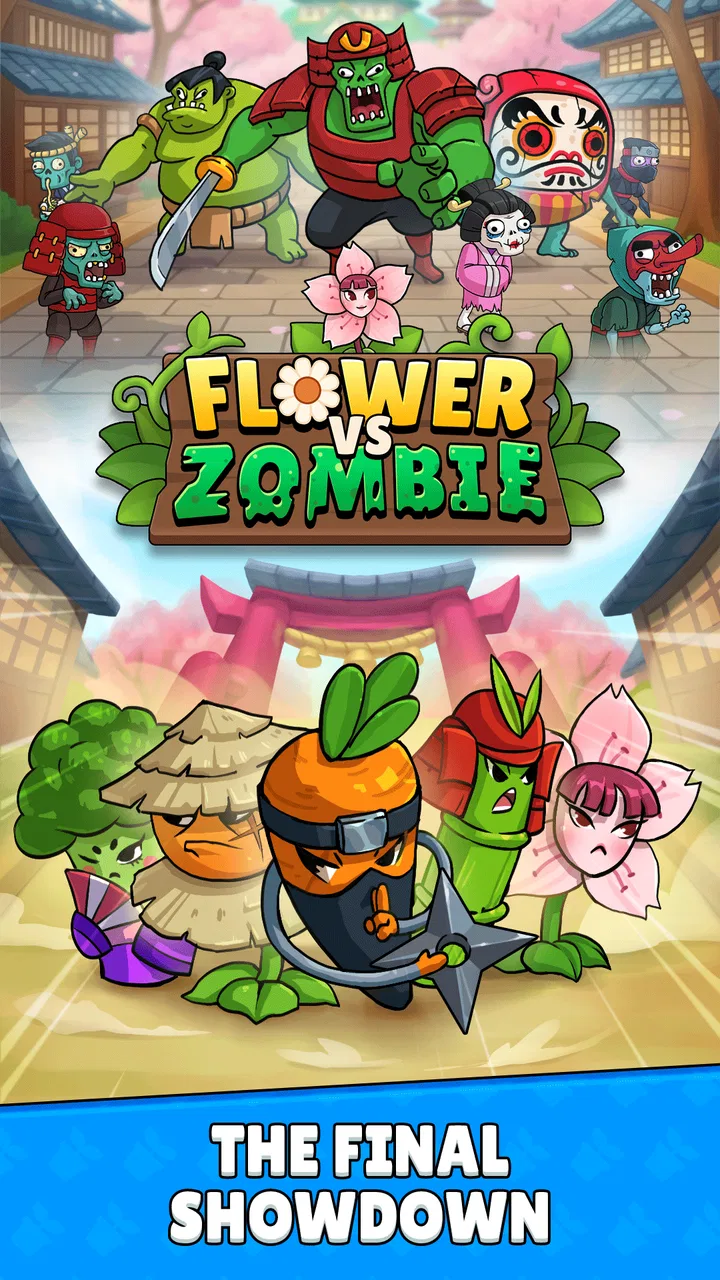
Flower vs zombie: City Defense
- 3.7
- Rating
- 1.00M
- Installs
- Free
- Price

 Analysis by App-foxy
I spent time with Flower vs zombie: City Defense as a casual strategy game, and my first impression was that its central idea is easy to understand: combine flowers, then use what you build to withstand incoming zombie attacks. That simple loop makes it approachable on a shared phone or tablet, especially when someone wants a game that can be explained in a minute rather than learned through a long tutorial.
It is a free game from HCC Games, listed for Everyone, with a store summary focused on merging flowers and defending against waves of zombies. The short description, “Flower vs Zombie,” says very little, so the real question is whether the merge-and-defense structure has enough decision-making to keep your attention after the novelty wears off. In my experience, it works best as a light strategy diversion rather than as a deep, highly competitive defense game.
The game is available for devices running Android 7.0 or later. It has passed one million installs and holds an average rating of 3.6 from roughly eight thousand ratings, which suggests a mixed but substantial audience. I would treat that rating as a useful warning to keep expectations balanced: the concept is accessible, but not every player will find the progression or pacing equally satisfying.
You May Also Like

 Blood Strike: 2.5 Anniversary
Blood Strike’s Loadouts Turn Every Drop Into a Tactical Gamble
A close look at Blood Strike’s custom loadouts: how fast access to signature weapons reshapes its battle royale rhythm, rewards preparation, and narrows the gap between fights.

 Pandora - Music & Podcasts
Pandora’s Music Is Easy to Start, but Harder to Recover
Pandora’s strength is its low-effort path from a seed to a station. Its weak spot is how much confidence it asks you to place in connection, setup, and quiet recovery.

 8 Ball Pool
 Is Built on Rivalries, Rematches, and Routine
A close look at the rivalries, rematches, shared routines, and unanswered safety questions that turn a quick pool match into a persistent mobile community.

 Samsung Music
’s Quiet Strength Is Playing What You Already Own
Its reach comes less from spectacle than from dependable access to a personal library. That simplicity is both the app’s strongest retention engine and its ceiling.

 AccuWeather: Weather Radar
AccuWeather Review: A Quick, Clear Forecast for Everyday Decisions
For everyday plans, the best forecast is the one you can understand quickly. AccuWeather makes rain timing, radar, and local conditions easy to act on, with a few trade-offs.

 Hill Climb Racing
Why Hill Climb Racing Still Turns Crashes Into One More Run
A tiny car, a bumpy hill and one more upgrade: Hill Climb Racing keeps resurfacing because its simple chaos makes every near-miss feel personal.
More From Our News Desk



How the merge-and-defense loop feels in everyday play
I find the appeal of Flower vs zombie: City Defense in the way one small choice leads into the next: combine flowers, see how that changes your defense, then decide what to do as pressure returns. That makes even a brief visit feel like a complete little test rather than a task to grind through. The key is noticing how each result shapes your next move, which is what makes the feedback rhythm worth considering.
A good fit for short shared-device sessions
The most natural way I see people using this game is in short bursts. Imagine a household tablet on a coffee table: one person plays while waiting for dinner, another takes over later, and nobody needs a long explanation before starting. The visual premise is friendly enough for a younger player to understand, while the defense objective gives an older player a reason to think about placement and timing.
That shared-device scenario is also where the game’s simplicity becomes useful. A player can hand over the device after a wave or a failed attempt without needing to explain a complicated character build, a long story, or a large inventory. The next person can look at the board and quickly understand that flowers are being combined and zombies are the immediate threat.
Still, I would not confuse easy access with automatic cooperation. Merge games often invite players to make quick combinations, while defense games reward planning ahead. If two people take turns casually, one may merge whatever is available while the other prefers to save pieces for a stronger arrangement. That difference can create more discussion than the game itself requires.
Where the strategy actually comes from
The interesting decision is not simply whether to merge. It is deciding when a merge is worth making and when keeping separate pieces gives you more flexibility. Combining flowers may improve your immediate defensive position, but using every available piece at once can leave fewer options when the next attack arrives. I found that the best mindset is to treat the board as a small resource puzzle rather than tapping through every possible combination immediately.
This is one of the more useful habits for new players: pause before making the obvious merge. Look at what is already defending, consider what space will be opened or occupied, and then decide whether the improvement helps now or only appears attractive because it is available. That extra moment is where the strategy feels more deliberate.
Another practical tip is to avoid judging a move only by the strength of the new flower. A merge can matter because it changes the shape of your board, clears room, or makes the next decision easier. In a game built around waves, a tidy position can be more valuable than a single impressive upgrade if the tidy position leaves you with several possible responses.
Why the game is not a full replacement for deeper strategy titles
Compared with more elaborate tower-defense games, this one places less emphasis on a wide roster of units, detailed maps, complex upgrade trees, or long-term planning across many systems. That is a strength when I want something readable and quick, but it is a limitation when I want a strategy game that rewards studying mechanics for weeks.
Traditional tower defense usually asks me to decide where to build, which route to prioritize, and how to balance several defensive roles. A merge-focused game shifts more attention toward combining available pieces and managing limited space. Players who enjoy arranging a board and making quick value judgments may prefer this structure. Players who want extensive customization, elaborate level design, or a large strategic toolkit may find it too narrow.
It also differs from a pure merge game. The zombie waves give each combination a reason to exist, so progress is not only about making a larger object. You are trying to prepare for pressure. That extra layer makes the decisions more meaningful, even though the overall experience remains lighter than a serious strategy title.
The household boundary: free does not mean frictionless
The game is free to download, but it includes in-app purchases ranging from $0.99 to $47.99 per item. That matters on a shared device. If children or several family members use the same phone or tablet, I would establish a clear rule before anyone starts playing: no purchase is made without asking the device owner.
I am not presenting that as a special feature of this game; it is simply sensible household practice whenever a free game offers optional purchases. The large gap between the smallest and largest listed items makes it especially important not to treat every on-screen offer as a minor expense. A shared device should have a clear boundary between playing and spending.
My preferred arrangement is simple. The person who owns the device handles any account or payment decisions, while other players use the game only for its free play. If the game is installed on a family device, keeping the conversation explicit is better than assuming everybody understands the same rules. This is particularly important when a younger player is attracted to faster progress or a more convenient in-game option.
I would also avoid promising a child that the game is entirely cost-free just because the initial download costs nothing. The accurate explanation is that the game can be played as a free title, while optional purchases are available. That distinction is easy for an adult to communicate and prevents unnecessary arguments later.
Taking turns without turning the board into a disagreement
Because this is a strategy game rather than a conventional multiplayer party game, shared use is mostly about taking turns. There is no need to invent a complicated family competition. A practical approach is to let one player handle a wave, then pass the device after the result. That gives each person a clear stopping point and reduces the chance that someone interrupts another player halfway through a decision.
For younger players, I would encourage them to explain why they want to merge before tapping. That turns a quick action into a small planning exercise without making the game feel like homework. An older player can ask questions such as, “What space will this open?” or, “Are you saving anything for the next attack?” The goal is not to take control of the board but to help the child notice that the best move is not always the biggest-looking move.
There is a trade-off here. Shared play can make the game more social, but it can also make mistakes feel public. If one person loses a wave after another person made a choice, blame can replace the fun. I recommend treating failed attempts as experiments. The game’s merge structure naturally supports that attitude because every round can reveal something about timing, space, and priorities.
Age context and the question of trust
The Everyone content rating makes the game easier to consider for a broad household audience. Its flower-versus-zombie premise is cartoon-like in concept rather than dependent on realistic horror, so it is more approachable than a darker survival game. Even so, an age label does not answer every parenting question. A child may be comfortable with the theme but still need help understanding spending, screen-time limits, or frustration after a difficult wave.
For a younger player, I would focus on three boundaries: how long the session lasts, whether purchases are allowed, and who gets the next turn. Those rules are more relevant to a shared device than any assumption that the game will manage the household for you. The game can supply the activity, but the adults still need to set expectations around it.
Trust also matters for older children and adults sharing one device. If someone changes the board or spends money, the issue is not only the game’s design; it is the absence of a clear agreement about access. I would keep the device owner involved in installation and payment decisions, and I would make sure every player knows whether progress is personal, communal, or simply whoever is holding the device at the time.
That last point is worth considering before installation. If several people want separate progress, a single shared device may become inconvenient. If the household is happy to treat the game as one communal activity, the arrangement is simpler. I would not choose this title as the main family game if everyone expects a separate, carefully protected profile on the same device.
Specific tactics that make the early experience smoother
My first recommendation is to value open space. A board crowded with low-level flowers can feel productive because there is a lot happening, but it can also reduce your ability to respond. Before every merge, ask whether the resulting position will leave room for the next useful combination. This is a small habit, yet it prevents the common mistake of filling the board with pieces that are individually harmless but collectively awkward.
Second, do not let the arrival of a zombie wave force every decision. Pressure encourages rushed tapping, and rushed tapping is exactly when a player loses track of what the board can become. I had better results when I separated urgent moves from attractive moves: deal with the immediate threat first, then use the remaining space for preparation.
Third, use turn-taking as a learning tool rather than merely a fairness rule. Let one player choose the merge and let the next player describe what they would have done differently after the wave. This works particularly well on a household tablet because the game’s decisions are visible. It creates coordination without requiring a formal multiplayer mode or a shared strategy guide.
Finally, decide in advance whether purchases are part of the experience. If the answer is no, play with that constraint from the beginning. A free strategy game is most useful for a family when everyone understands that progress may take patience and that convenience items are not necessary household expenses. If the answer is yes, the device owner should remain the person who approves each transaction.
Version, support expectations, and practical fit
The current version is 0.0.75, and the game was released on August 6, 2025. Those details place it in an early version context, so I would approach it as a developing experience rather than a finished, long-established strategy platform. That does not make it a poor choice, but it does affect how much polish and depth I would expect compared with mature alternatives.
For me, the early-version label reinforces the importance of playing for the core loop. If merging flowers and defending against waves is already enjoyable, the game can be worthwhile as a compact pastime. If you need a large amount of content, highly refined balance, or a settled competitive environment, I would choose a more established title in the strategy category instead.
The minimum operating-system requirement of Android 7.0 or later keeps the technical entry point relatively broad for Android users. That is helpful for a shared household device that is not brand new. I would still judge the installation by the actual device experience: a game can meet the operating-system requirement and yet feel less comfortable on a small screen, an older battery, or a device that several people already depend on.
Who should play it, and who should skip it
I would recommend this game to someone who likes the satisfaction of combining pieces but wants a clear defensive purpose behind each move. It suits players who enjoy short sessions, visible progress, and decisions that are easy to explain to another person. It is also a reasonable choice for a household looking for a casual game that can be passed around without a long onboarding process.
I would be more cautious about recommending it to a player who wants a deep strategy sandbox. If your ideal game includes extensive unit specialization, intricate maps, elaborate campaigns, or highly detailed control over every defensive variable, this may feel too streamlined. A conventional tower-defense game is likely the better option in that case.
I would also skip it for a shared device if the household cannot agree on spending rules or turn-taking. The game’s simplicity makes it easy to start, but that same accessibility can encourage people to pick it up casually and make decisions without checking who owns the current progress. The title is not the right fix for a household that needs separate accounts, strict access boundaries, or a fully cooperative experience.
My household verdict
After playing it, I see Flower vs Zombie: City Defense as a friendly, lightweight strategy game with a useful shared-device quality. Its strongest feature is the way it turns a simple merge action into a small defensive decision. The flowers make the board approachable, while the zombie waves give each choice urgency and purpose.
Its weaknesses are just as clear. The format may not satisfy players looking for the depth of a traditional tower-defense game, and the mixed 3.6 average rating suggests that the accessible concept does not work equally well for everyone. The presence of in-app purchases also means a family should set spending boundaries rather than assuming the free download settles the cost question.
For my own recommendation, I would install it on a household device when the goal is short, turn-based entertainment that adults and younger players can understand together. I would introduce it with a simple agreement: one person plays at a time, no purchase happens without permission, and failed waves are treated as learning rather than somebody’s fault. Under those conditions, the game has enough charm to earn a place among casual family diversions.
My honest bottom line: choose it for approachable merge strategy and quick shared sessions, not for a deep long-term defense simulation. If that distinction matches what you want, the free entry point makes it easy to try; if you need separate household identities, extensive strategic depth, or a more mature alternative, another game will serve you better.
FAQs for Flower vs zombie: City Defense
01What is the main objective of Flower vs Zombie: City Defense?
In Flower vs Zombie: City Defense, the primary objective is to protect your city from waves of incoming zombies using a variety of strategically placed flowers. Each flower has unique abilities and strengths, and players must plan their defenses carefully to fend off the increasingly challenging zombie hordes. Success requires strategic planning and resource management.
02What are the in-app purchases available in Flower vs Zombie: City Defense?
Flower vs Zombie: City Defense offers several in-app purchases to enhance gameplay. Players can buy additional flowers, power-ups, and resources to strengthen their defenses. Some packages provide exclusive items or boost progression speed, allowing players to tackle tougher levels with greater ease. These purchases are optional but can enhance the gaming experience.
03Is Flower vs Zombie: City Defense suitable for children?
Yes, Flower vs Zombie: City Defense is suitable for children, featuring colorful graphics and a family-friendly theme. The game is designed to be entertaining for all ages, with simple controls and a humorous take on the zombie genre. However, parents should be aware of in-app purchases and may want to supervise or disable them for younger players.
04Can Flower vs Zombie: City Defense be played offline?
Flower vs Zombie: City Defense can be played offline, allowing players to enjoy the game without a constant internet connection. However, certain features, such as leaderboards, social sharing, and some updates, require an online connection. Offline play is perfect for uninterrupted gaming on the go, but online access provides a fuller experience.
05What are the system requirements for Flower vs Zombie: City Defense?
For Android devices, Flower vs Zombie: City Defense requires Android 5.0 or higher, while iOS devices need iOS 11.0 or later. The game is optimized for both smartphones and tablets, ensuring smooth performance across devices. Adequate storage space is also necessary for installation and updates, so checking available space is recommended before downloading.
Pros
- Engaging tower defense gameplay.
- Colorful and appealing graphics.
- Variety of unique plant units.
- Strategic challenges increase over time.
- Frequent updates and events.
Cons
- In-app purchases can be pricey.
- Occasional ads interrupt gameplay.
- Requires constant internet connection.
- Resource management can be complex.
- Limited offline play options.

Flower vs zombie: City Defense
Gallery